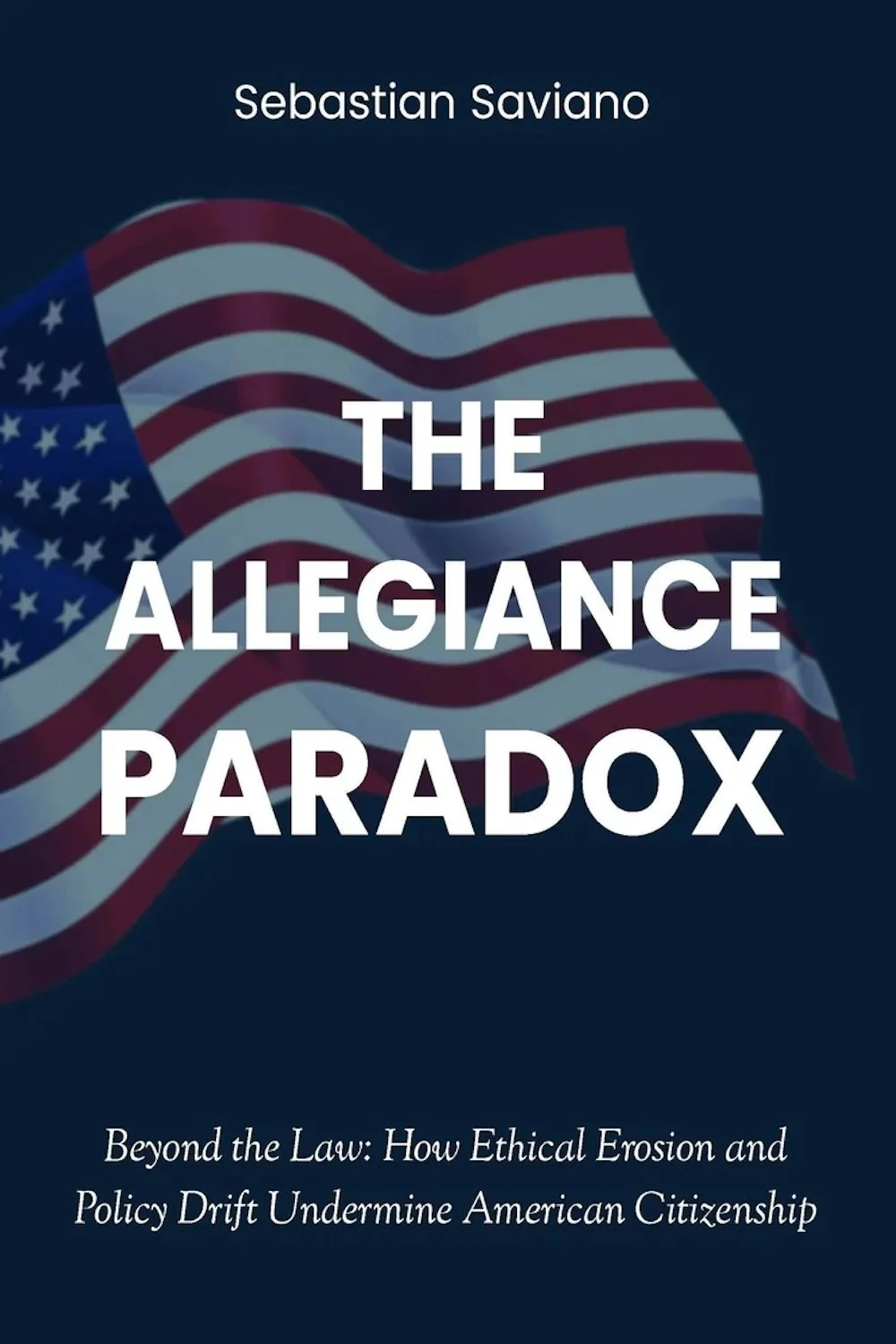
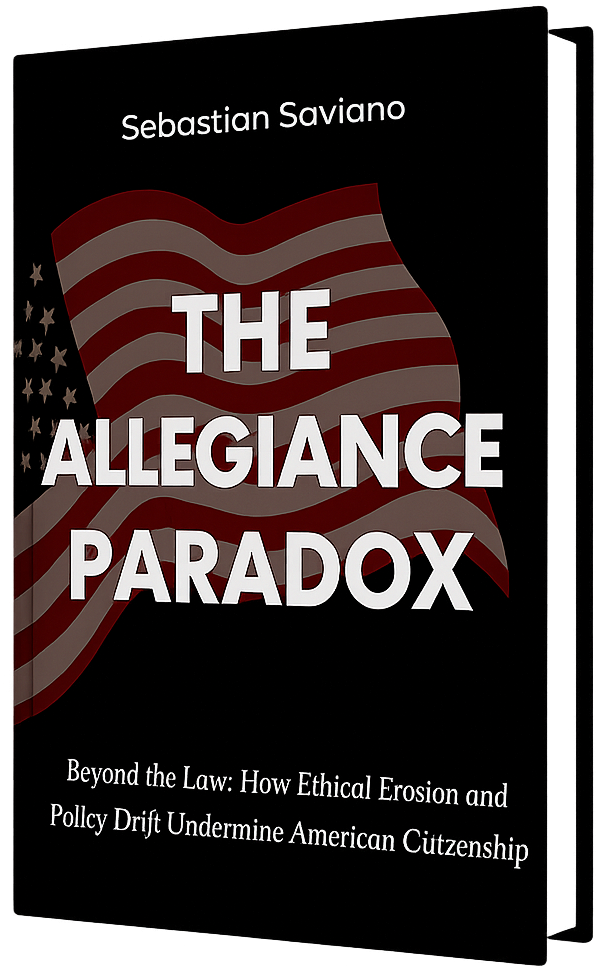
The Allegiance Paradox
Beyond the Law: How Ethical Erosion and Policy Drift Undermine American Citizenship
Series: Book One of The Collapse of Trust
Publisher: Statera Press (2025)
Trade distribution: Ingram
“With clarity and power, Saviano presents citizenship as the moral bedrock of democracy—a thoughtful, reform-minded consideration that moves beyond political binaries. Not anti-immigrant but rather pro-citizen.” — BookLife Review
For The Allegiance Paradox, I’d make the connection to the evolution of American citizenship and its contemporary challenges more explicit while preserving the substance:
The Allegiance Paradox examines the evolution of American citizenship and the legal, institutional, and ethical challenges reshaping it. Sebastian Saviano argues that citizenship has gradually become unmoored from the duties, shared purposes, and forms of allegiance that once helped bind a diverse nation together.
Drawing on legal analysis, history, and comparative models, the book traces how dual citizenship, policy drift, globalization, individual mobility, and the commodification of passports have altered the meaning of civic membership. It shows how institutions adapted to these changes without developing a renewed ethic of allegiance capable of balancing personal freedom with common obligation.
Saviano then outlines pragmatic reforms—from reconsidering birthright citizenship through parental jurisdiction to modernizing the Oath of Allegiance and creating transparent digital registries—designed to anchor membership not only in legal status, but also in civic participation and responsibility.
This is not a politics of exclusion. It is a framework for restoring alignment between rights and responsibilities, national security and openness, and personal identity and democratic purpose. By bringing together political science, complexity theory, and constitutional law, The Allegiance Paradox offers a blueprint for rebuilding trust in the idea of citizenship—one that honors pluralism without surrendering coherence and asks what meaningful belonging should require in a modern democracy.
What You’ll Learn
Reaffirming allegiance: Why civic responsibility must be re-centered alongside rights.
Dual citizenship and security: Real-world tradeoffs in defense, elections, and civil cohesion.
Rethinking birthright citizenship: A parental-jurisdiction model that honors equality under law.
Transparency and trust: How digital citizenship registries can protect privacy while strengthening accountability.
Modernizing the Oath: A 21st‑century oath that is inclusive, meaningful, and enforceable.
Participation over status: Tying the privileges of citizenship to measurable civic contribution.
FAQ
Is this a book about restricting immigration?
No. It is about rebuilding coherence between rights and responsibilities so that a diverse, open society can function with trust.
Is dual citizenship inherently harmful?
Not inherently—but it creates real tradeoffs in national security, elections, and civic solidarity that require transparent, enforceable rules.
What does a “parental‑jurisdiction” model of birthright citizenship mean?
That citizenship at birth should recognize a child’s legal jurisdiction through their parents’ standing under U.S. law, ensuring equal protection while aligning membership with responsibility.
Is the Oath of Allegiance exclusionary?
It shouldn’t be. A modernized oath can be inclusive and measurable—tying privileges to civic participation, not identity.
Is there a policy agenda?
Yes: practical proposals to update birthright rules, the oath, transparency mechanisms, and participation metrics. The book details how to implement them with constitutional and ethical guardrails.
Who is it For
Citizens and residents seeking a principled, non‑ideological path to unity.
Policymakers, jurists, and civic leaders facing complex tradeoffs.
Scholars and students in law, political science, security studies, sociology, and public policy.
Journalists and advocates seeking clear, verifiable frameworks.
Inside the Book
Part I — The Erosion
Chapters 1–3: Historical anchors of allegiance; the rise of policy drift; the market for passports.
Part II — The Fault Lines
Chapters 4–7: Dual citizenship in national security, elections, and civic life; institutional incentives and their unintended consequences.
Part III — Rebuilding Alignment
Chapters 8–9: A reform framework—parental jurisdiction for jus soli, oath redesign, transparent registries, and civic participation metrics.
The Collapse of Trust Series
The Collapse of Trust is a four-volume nonfiction investigation into the fracturing of civic allegiance, institutional credibility, and cultural coherence in contemporary American democracy. At once diagnostic and synthetic, the series culminates in The Collapse of Trust, a capstone work that integrates the foundational arguments of the preceding volumes—The Allegiance Paradox, Legitimate Distrust, The Theater of Trust, and Overruling Common Sense.