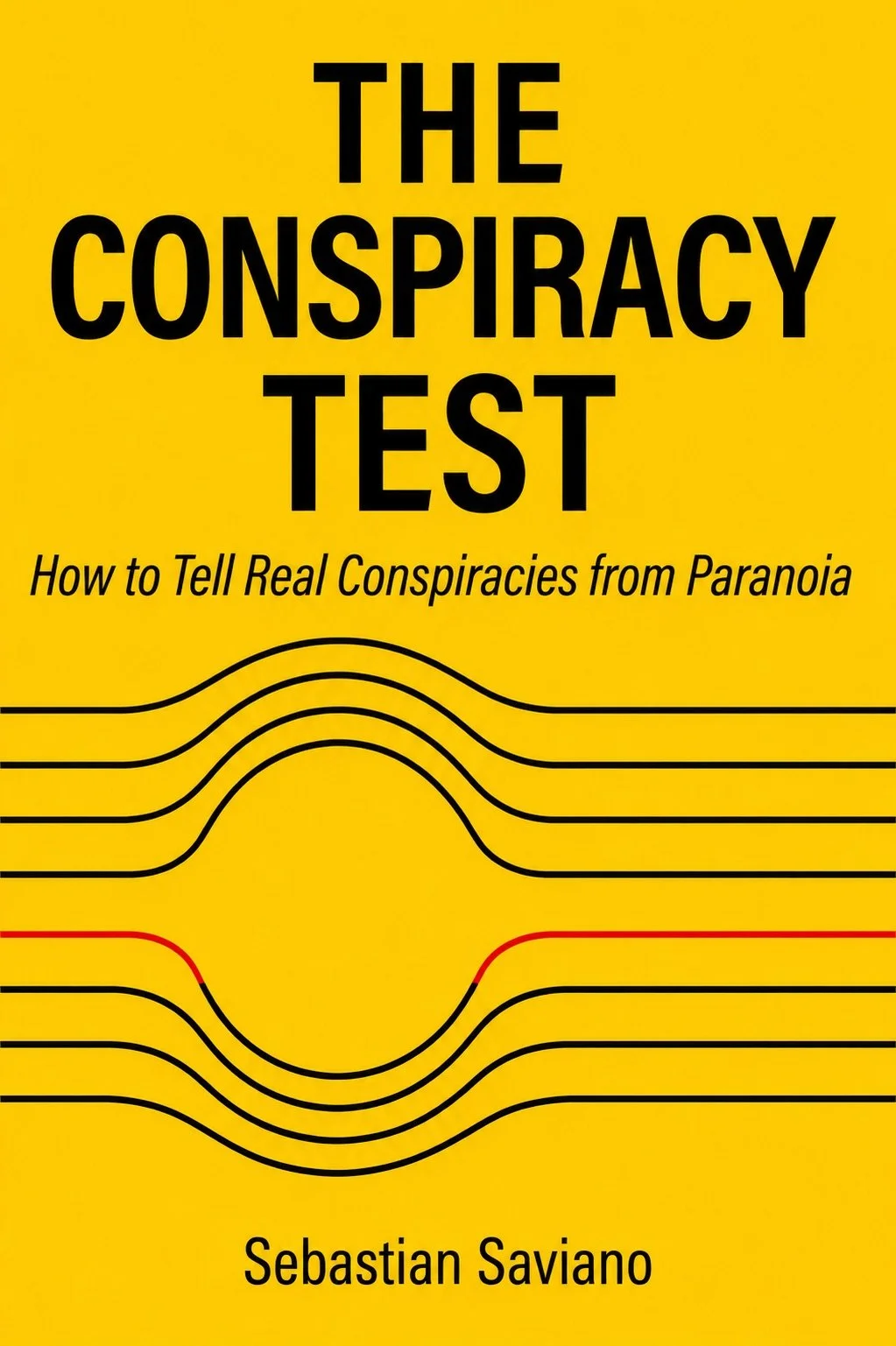
THE CONSPIRACY TEST
How to Tell Real Conspiracies from Paranoia
FORTHCOMING
A new trade nonfiction book from Sebastian Saviano
The Conspiracy Test: How to Tell Real Conspiracies from Paranoia is a trade nonfiction book by Sebastian Saviano about conspiracy theories, evidence, and critical thinking. Some real conspiracies are dismissed until they are proved. Other claims persuade millions without credible evidence. The book asks the question that matters before the verdict is in: How can you tell the difference?
Real conspiracies rarely announce themselves. They have to be inferred from the traces they leave behind: money that moves, messages that cross, people who know too soon, costly efforts to maintain secrecy, strangely synchronized behavior, and secrets that eventually escape. Like a black hole, hidden coordination becomes visible through what it bends.
Drawing on political scandals, corporate fraud, financial manipulation, institutional failures, historical cases, and famous false theories, Sebastian Saviano shows readers how to distinguish genuine coordination from coincidence, incompetence, ordinary secrecy, shared incentives, and the patterns our own minds can manufacture.
The goal is not to make readers more suspicious. It is to make them more accurate.
From Legitimate Distrust to The Conspiracy Test
Legitimate Distrust: Why Conspiracy Theories Grow When Institutions Fail examined why distrust can become rational when institutions conceal, evade, contradict themselves, or fail to account for their conduct.
The Conspiracy Test takes the next step.
Once distrust may be justified, how do we determine what that distrust actually warrants?
The new book moves from explaining the conditions that produce suspicion to giving readers a practical method for judging whether hidden coordination is genuinely becoming more plausible—or whether ordinary events are being turned into extraordinary proof.
The Conspiracy Test is a standalone trade book and does not require readers to have read Legitimate Distrust.
The Six Tells and the Conspiracy Test
Every real conspiracy leaves traces.
At the heart of the book are Six Tells—recurring signs that hidden coordination tends to produce.
In poker, a tell is an involuntary signal that reveals something a player is trying to hide. Conspiracies have tells too. Secret coordination is never frictionless: people have to communicate, divide roles, move money, manage risk, synchronize behavior, and keep one another quiet. Those necessities leave traces.
The Six Tells are the recurring traces that can reveal a hidden arrangement—not proof by themselves, but signals that deserve closer examination.
Coordination Residue
The intersections left behind when people plan together.
Premature Knowledge
Actions that suggest someone knew something before they reasonably should have.
Costly Secrecy
The money, effort, restrictions, and machinery required to keep something hidden.
Aligned Incentives
The bargain that gives each participant a reason to cooperate—and not defect.
Suspicious Synchrony
Behavior that becomes difficult to explain as independent action.
The Leak
The document, witness, record, mistake, or defection through which the secret begins to escape.
But every Tell has a trap. Coincidence can look like coordination. Privacy can look like concealment. Shared incentives can make people act alike without ever speaking.
The Conspiracy Test brings those signals together in a practical five-question method for deciding whether a claim deserves dismissal, attention, investigation, or serious belief.
You rarely see a conspiracy. You see what it bends.
Publication information and preorder links will be announced here.
The Conspiracy Test: How to Tell Real Conspiracies from Paranoia
Sebastian Saviano
Statera Press
Hardcover ISBN: 978-1-971828-17-6
Paperback ISBN: 978-1-971828-10-7
E-Book ISBN: 978-1-971828-13-8